

Orpheus at the Steps
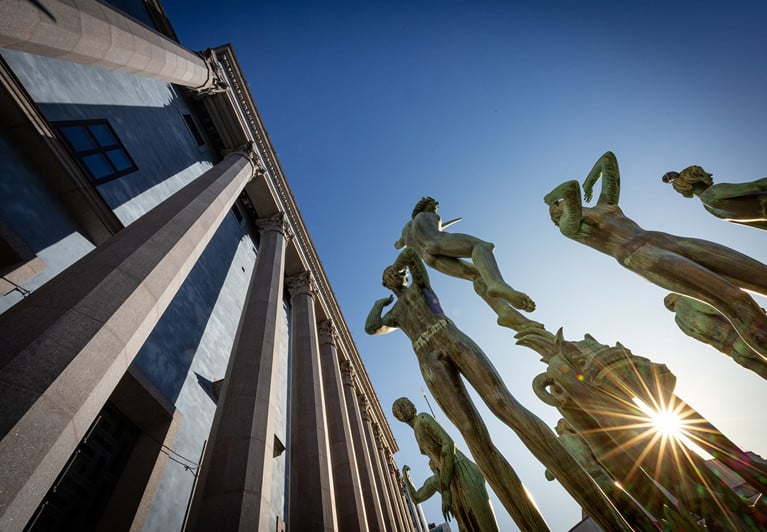
Orpheus was finally installed in 1936 – only to vanish one night in 1938.
The sculptor Carl Milles (1875–1955) created the celebrated statue of Orpheus – known as the Orpheus Group or the Orpheus Fountain – at the foot of the steps leading up to Konserthuset from Hötorget. In Greek mythology, Orpheus represents the art of music and the lyre.
The sculptural group was installed only in 1936, ten years after the inauguration of Konserthuset and eleven years after Milles had won the commissioned competition. The delay was due to lengthy and intense discussions before a final decision could be passed by Stockholm City Council – by a margin of just one vote.
Carl Milles is also represented inside the building. In the Grand Foyer stand statues depicting the four Muses – Erato, Polyhymnia, Terpsichore and Euterpe. These were previously positioned on balconies flanking the stage in the Main Hall until the restoration in the 1970s.
When Orpheus Escaped
In 1938, the composer Hilding Rosenberg (1892–1985) wrote the music for the ballet Orpheus in Town. In the story, the statue of Orpheus outside Konserthuset comes to life and ventures into Stockholm’s nightlife in search of Eurydice. He finds her at the stage door of the Royal Swedish Opera, and the two end up in a nightclub. After a quarrel, they are forced to flee, and Orpheus returns to his place as a statue.
From the ballet score, Rosenberg later compiled the frequently performed concert version Dance Suite from Orpheus in Town, which The Royal Stockholm Philharmonic Orchestra premiered at Konserthuset in the spring of 1940.
Säg gärna till om du vill att vi behåller den svenska titeln Orfeus i sta’n parallellt första gången den nämns, för tydligare lokal förankring.
Orpheus to be Refreshed
Beata Holmberg, Public Art Curator at Stockholm konst, explains that the Orpheus Group will be cleaned starting on 13 April 2026. The bronze surface will be treated carefully, and certain areas will be patinated to create a more even green patina. Finally, the sculpture will be treated with wax, which protects the bronze surface and gives it a more uniform appearance.
Before the cleaning begins, a final nymph will be reinstalled.
“The sculpture has been in the workshop, where the original iron structure has been replaced with one in stainless steel. At the same time, we will also install two details on the sculpture that have previously been missing: two plants placed at the feet of two of the nymphs. Copies of the plants have been cast in bronze,” says Beata Holmberg.
During the work, a protective fence will be erected around the sculpture group. The sculpture itself will not be covered. The work is planned to be completed around 1 June.
“The sculpture will appear cleaner and better maintained, while the green patina is preserved and enhanced. The aim is to create a more even patina that highlights the sculpture’s forms and details.”