

Swedish Grace
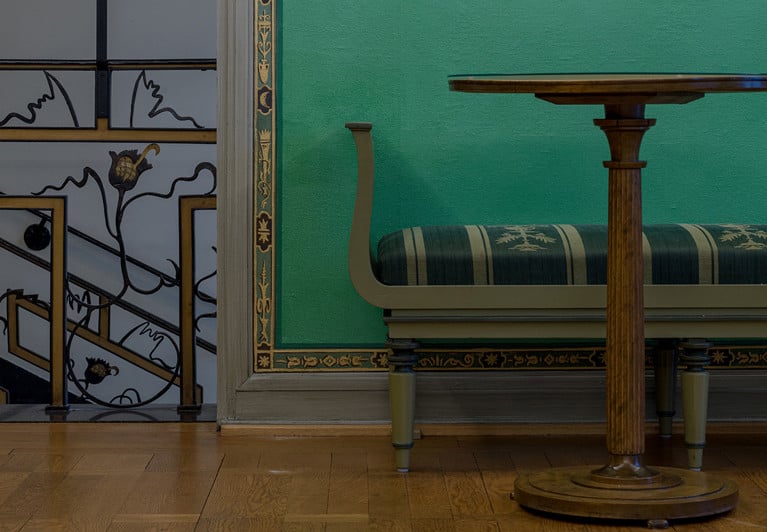
A symbol of an era. Quality, craftsmanship and playfulness characterise the hundred-year-old landmark at Hötorget.
Faith in the Future
When Konserthuset Stockholm was inaugurated in 1926, it was not only a new home for The Royal Stockholm Philharmonic Orchestra that opened its doors. The building also became one of the clearest expressions of Swedish Grace – the elegant and restrained Nordic Classicism that responded to the new social ideals of the early twentieth century.
A hundred years later, Tengbom’s blue palace at Hötorget still stands as a symbol of that era, where architecture, art and music interact in an unusually coherent whole.
Cilla Robach is Head of Collections and Curator of Twentieth- and Twenty-First-Century Design at the Nationalmuseum, where in 2022 she curated the museum’s major exhibition on Swedish Grace. In what way is Konserthuset a seminal work of Swedish Grace?
“You first have to understand the period in which Swedish Grace emerged. After the First World War, Europe was marked by both uncertainty and optimism about the future. The need for a new society felt urgent, and there was agreement that something new had to be built – but not agreement on how. The modernists wanted to move towards mass production and international ideals, while the architects of Swedish Grace sought to create the modern through tradition,” explains Cilla Robach.
Classical Language, Modern Simplicity
In Stockholm, this idea took concrete form in a series of public buildings during the 1920s. City Hall was completed in 1923, Konserthuset in 1926 and the Public Library in 1928. That these ambitious projects were realised despite economically challenging times says much about the high aspirations of the period.
“There was a strong desire to offer people quality. These buildings were open to everyone. Konserthuset in particular embodied a clear ambition to democratise access to music,” says Robach.
The architect Ivar Tengbom combined the formal language of antiquity with modern simplicity. The blue-rendered façade and the colonnade facing Hötorget convey classical dignity, yet the proportions are free and the interpretation personal.
“There is often a playfulness in Swedish Grace,” Robach notes. “Forms are borrowed from history but used in new ways, almost as a wink.”
This balance between tradition and renewal characterises the entire building. As visitors pass through the heavy doors, a world unfolds in which symmetry, materials and the handling of light are carefully orchestrated.
Details, Details!
Swedish Grace is not only about monumental architecture, but just as much about the details – the small gestures that create the whole.
The original drinking fountains in ceramic and metal remain, as do light fittings that cast a soft glow across the walls. Stair rails, door handles and floor patterns are executed with the same precision as the grand spaces.
“There is a care for detail that we rarely see today,” says Robach. “There was pride in craftsmanship and in creating environments that showed respect for visitors.”
Konserthuset is also a Gesamtkunstwerk – a total work of art. Isaac Grünewald’s paintings, Carl Milles’s sculptures, Carl Malmsten’s furniture and Ewald Dahlskog’s decorative patterns, together with the architecture itself, form an integrated whole in which art, design and function are closely interwoven.
In the stairwells, Ansgar Almqvist’s small sculptures depict figures riding fantastical creatures – details with no practical function, yet ones that heighten the experience.
“They are among my favourites! Entirely unnecessary, and precisely for that reason wonderful. Pure joy for the eye – and very revealing of the spirit of the time,” says Cilla Robach.
The Paris Exposition
Swedish Grace achieved its international breakthrough at the Exposition Internationale des Arts Décoratifs in Paris in 1925, where Swedish design attracted considerable attention. The movement is often seen as a Nordic variant of Art Deco, though with simpler forms and a greater emphasis on materials, proportion and craftsmanship.
“That was when Sweden became a design nation in the eyes of the world. The attention was enormous, and the international recognition still shapes the image of Swedish design today.”
What allows Swedish Grace to endure is its balance between monumentality and human scale. Columns and symmetry lend gravitas, while the details make the spaces inviting. Beauty is not an end in itself, but a means of creating dignity in the shared public realm.
Living Design History
A century after its inauguration, Konserthuset remains a living embodiment of this idea. At a time when architecture is often driven by speed, economics and spectacular gestures, Swedish Grace reminds us of something else: that lasting value is created through care, proportion and sensitivity to materials.
Konserthuset is therefore not merely a stage for music, but a piece of design history in active use. Every handrail, every door handle and every wall sconce bears witness to an era that believed in the importance of culture and form in the building of society.
And perhaps that is why the building still speaks to us so clearly – as a monument to the idea that beauty, craftsmanship and democracy belong together, here with music at the centre.
— Göran Persson