

The Architect
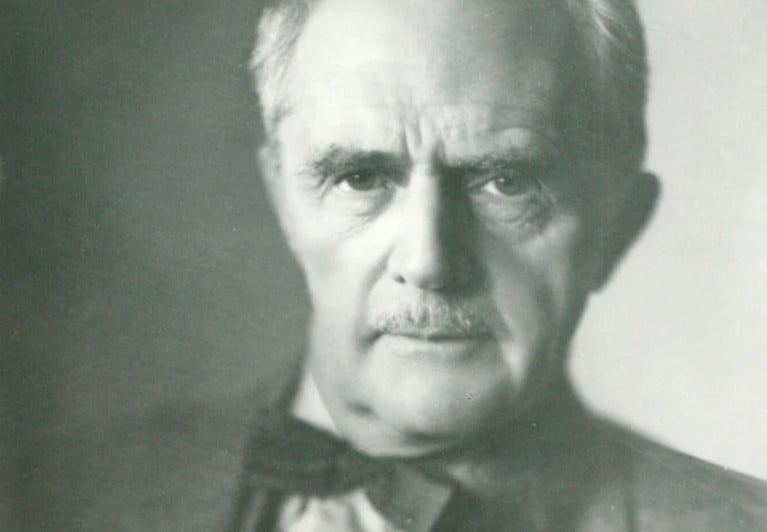
Ivar Tengbom won the architectural competition for Stockholm’s long-awaited concert hall.
Ivar Tengbom (1878–1968) was a Swedish architect and civil servant. Among his most renowned works are Konserthuset and the Matchstick Palace (Tändstickspalatset).
He completed his secondary education at the Higher General Grammar School in Skara and went on to study at Chalmers University of Technology in Gothenburg and at the Royal Academy of Fine Arts in Stockholm, which he left in 1901 having been awarded the Royal Medal. Study trips followed to Denmark in 1903 and to France in 1905–06. Tengbom served as Professor at the Royal Institute of Art from 1915 to 1920.
In 1906, Tengbom founded the architectural practice Tengbom Architects. Within a decade, the firm employed 25 people. His son Anders Tengbom (1911–2009), along with his grandsons, the interior architect Jonas Tengbom and the architect Svante Tengbom, also worked at Tengbom Architects, carrying forward Ivar Tengbom’s legacy.
In 2006, Tengbom Architects celebrated its centenary and is thus one of the oldest architectural practices in the world still in operation.
Together with his partner Ernst Torulf, Tengbom took part in a series of competitions between 1903 and 1912 that marked the breakthrough of National Romanticism in Sweden. They were awarded second prize for Engelbrekt Church (1906) and won first prize for Borås Town Hall (1907) and Högalid Church (1911).
In 1920, Ivar Tengbom achieved his major breakthrough when he won the competition to design Konserthuset in Stockholm with his proposal The Red Heart. Constructed between 1924 and 1926, Konserthuset became a complete manifestation of Nordic Classicism in Sweden at the time – internationally recognised under the name Swedish Grace.
In the years that followed, Tengbom was in great demand. Among other projects, he designed several buildings for Stockholm’s Enskilda Bank (1915), the Stockholm School of Economics (1925) at 65 Sveavägen, and the Matchstick Palace (1928) at Kungsträdgården for the financier Ivar Kreuger.
In the early 1930s, like his colleague Gunnar Asplund, Tengbom turned towards a restrained Functionalism. Notable examples include the Esselte Building (1928–34) on Vasagatan, Citypalatset (1930–32) at Norrmalmstorg, the Church of the Ascension (Himmelfärdskyrkan) in Höganäs, and two buildings for the Swedish Tobacco Monopoly (1930–32 and 1933–38) on Maria Bangata. Here, the radical Functionalist Nils Ahrbom was an important collaborator.
Tengbom’s works also include the Värmekyrkan in Norrköping and one of the buildings in the Kåkenhus quarter in Norrköping’s former industrial district, as well as the water tower in Tornparken in Sundbyberg.
One of his final major projects was the Bonnier Building in Stockholm, realised in 1946 together with his son Anders Tengbom following their first prize in the architectural competition of 1937. Between 1947 and 1949, Ivar Tengbom carried out a major remodelling of Skara Cathedral, guided by the principle that interior elements from different periods should complement and interact with one another within the church space.
Source: Wikipedia