

The Read Heart
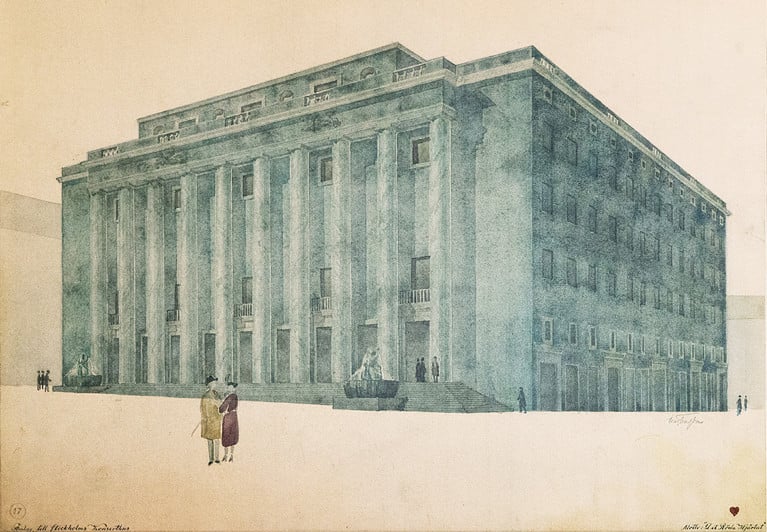
An architectural competition for a concert hall was announced in 1919. Ivar Tengbom won with his proposal The Red Heart.
The history of Konserthuset begins with an orchestra – an orchestra without a home. It was with the founding of the Stockholm Concert Society in 1902, and its orchestra, known as the Concert Society Orchestra, that the need for a larger concert hall began to grow. This orchestra was also the seed of today’s The Royal Stockholm Philharmonic Orchestra.
A City and a Musical Life in Transformation
In 1919, the Konserthuset Stockholm Foundation was established to oversee the future building, which would become one of the first in Sweden designed specifically for orchestral music.
The models came from international music capitals. Sweden was now to have its first true concert hall. Through fundraising and a lottery, sufficient funds were raised to launch, as a first step, an architectural competition.
Thirty-four proposals were submitted. Common to all of them – in accordance with the brief – was that the main entrance faced Sveavägen. Sveavägen was envisioned as the grand new esplanade leading into Stockholm from the north. At the time, the area was undergoing major transformation and was on its way to becoming a new city centre, making the location of Konserthuset a forward-looking choice.
A Temple of Music
Ivar Tengbom won the competition with his proposal The Red Heart: a blue building leading into the heart where the music pulses. A decisive reason for preferring Tengbom’s design was that he placed the large and small halls on the same level, side by side, allowing concerts to take place simultaneously in both without disturbance.
On the designated site in the Hästhuvudet block – then consisting of stables and small trading premises beside the market stalls of Hötorget – Tengbom envisioned raising a classical Greek temple in honour of music. Externally, the building is austere. The main entrance is framed by ten 18-metre-high columns in warm grey granite.
But what of the entrance facing the planned esplanade? According to an urban development plan, Sveavägen was to lead directly to the new building, with traffic diverted westwards along Kungsgatan just before the hall, then across Hötorget and onwards along Sergelgatan. This would have positioned Konserthuset between two squares: Hötorget, with new traffic routes, and another square to the east, where Sveavägen today continues straight ahead towards Sergels torg. An alternative proposal was to turn the entrance towards the existing Hötorget.
A lively debate followed, with advocates and critics on both sides, before the proposal for an entrance from Hötorget ultimately prevailed. Tengbom was required to revise his plans and adapt the design to the terrain, creating the steps that today lead up from the sloping square. Opening the building towards the square was, in fact, entirely in keeping with Tengbom’s vision of a concert hall for all, inspired by Athens, the cradle of democracy.
The architect Gunnar Asplund was among those who strongly argued for turning the main entrance towards Hötorget. In one article, Asplund wrote: “if the principal façade were turned towards Hötorget […] it would appear monumental, it would be bathed in sunlight, and the market trade would form a picturesque counterpoint to the severity of the colonnade …”
Konserthuset’s large and “democratic” public spaces were also innovative for their time – all social classes were welcomed through the same entrance doors. This was not the case at venues such as the Royal Dramatic Theatre and the Royal Swedish Opera, where classes were kept separate.
“Swedish Grace”
The winning architect, Ivar Tengbom (1878–1968), founded Tengbom Architects in 1906 – today one of the oldest architectural practices in the world still in operation. He was also responsible for the Stockholm Enskilda Bank building (now SEB) at Kungsträdgården and the Stockholm School of Economics on Sveavägen.
The commission to design Konserthuset marked Tengbom’s major breakthrough in the 1920s and stands as an outstanding example of Nordic 1920s Classicism – internationally known as Swedish Grace.
Alongside Konserthuset, the Stockholm Public Library is the most renowned building on Sveavägen: another masterwork of Swedish 1920s Classicism, designed by Gunnar Asplund and inaugurated two years after Konserthuset, in 1928.
Inauguration, 7 April 1926
Konserthuset was built between 1923 and 1926, primarily with the help of private donations. A significant contribution – made some years after her death – came from Rosa Nachmanson (1852–1916). She was the daughter of the pastry chef Wilhelm Davidson (1812–83), who founded the restaurant Hasselbacken on Djurgården in the mid-19th century. Rosa Nachmanson left a considerable fortune which, in accordance with her will and together with funds from her brother Ernst Davidson (1850–1919), provided the initial financial foundation for the construction of Konserthuset.
Konserthuset was inaugurated on 7 April 1926 at a final cost of 4.6 million kronor, equivalent to approximately SEK 140 million today. Since its inauguration, Konserthuset has been the home of The Royal Stockholm Philharmonic Orchestra (originally the Stockholm Concert Society Orchestra and later the Stockholm Philharmonic Orchestra). Today, the orchestra presents around 100 concerts annually at Konserthuset.
The Nobel House planned by the Nobel Foundation at around the same time was never built. Instead, since 1926 Konserthuset has most often been the venue for the annual Nobel Prize Award Ceremony on 10 December, at which The Royal Stockholm Philharmonic Orchestra also performs.
More Than a Concert Hall
From the outset, Konserthuset functioned almost as a broad civic cultural centre. Theatre performances were staged here, for example. The “Konserthusteatern” was active from 1926 to 1942 and for a time was known as the “Ekman Theatre”, after Gösta Ekman the Elder.
Film screenings also took place. From an early stage, the halls were used for large association gatherings and other events. Throughout its history – in line with the original vision – Konserthuset has been hired out for external events alongside its core orchestral activities. Retail premises at street level were part of the concept from the very beginning.
Today, Konserthuset frequently hosts major award ceremonies, including the August Prize, named after August Strindberg, and the Astrid Lindgren Memorial Award (ALMA).
The Choice of Colour
Ivar Tengbom wished to create a blue building in honour of music – sky blue. He believed the colour would lend the building a sense of lightness, almost as if it were floating. The shade is known as coelin blue (from the Latin caelum – sky). Another likely reason was that the colour would accentuate the building within a cityscape otherwise dominated by different tones.
The artist Isaac Grünewald (1889–1946) assisted Tengbom in developing this particular shade. The same Grünewald was later commissioned to create the paintings in Konserthuset’s small hall – the chamber music hall that subsequently took the name Grünewald Hall.
The façade colour naturally caused a stir, though it was also appreciated by many from the outset. Yet only a few years after the blue Konserthuset was completed, the colour began to change. A chemical reaction with the underlying plaster was probably responsible, gradually giving the building a browner hue. Many older Stockholmers remember Konserthuset as brown.
During the renovation of 1971–73, the building regained its blue colour, albeit in a somewhat paler shade than Tengbom and Grünewald had intended. Only in 1997, during a further repainting, did Konserthuset receive a more accurate blue. The most recent façade renovation, in 2025–26, was preceded by careful analysis to determine the precise shade originally envisaged.
Over the years, a number of imaginative explanations have circulated regarding the building’s colour. The most persistent claims that the expensive imported paint was stolen after arriving at the Free Port of Stockholm, forcing the use of an inferior substitute due to lack of funds. According to this enduring – though unverified – rumour, this would explain why the façade faded and the building long appeared a dull brown.