

The Three Halls
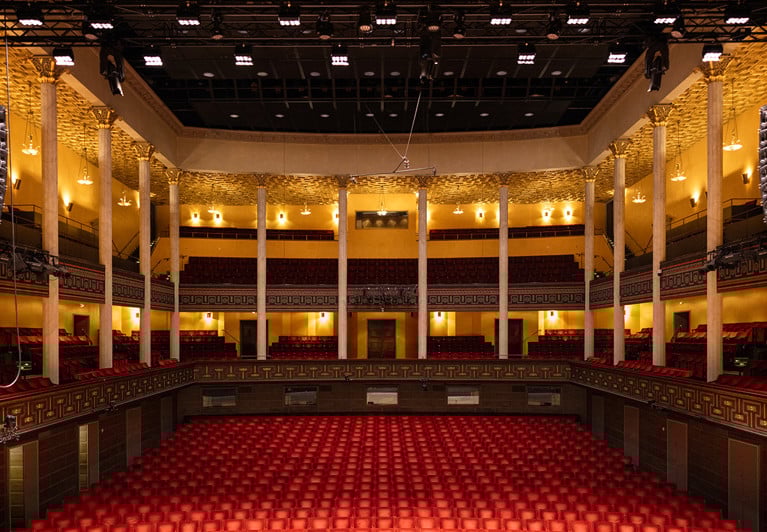
The Main Hall is a meeting place – a public square within Konserthuset.
Hötorget’s Sister Square
In the Main Hall, a meeting place unfolds: this is where Ivar Tengbom’s vision is most clearly expressed. He wanted the hall to appear as a public square – an open space surrounded by colonnades, with the stage as the focal point at one short end. A false perspective behind the stage, with four statues by Carl Milles placed in their own balconies, suggested a continuation outwards into an imagined Greek landscape.
The original grey-brown tones of the stalls, with their deep red seats, gradually lightened towards the ceiling – the sky. A white “heavenly vault” rested between the capitals of the columns. The ceiling was originally covered with sailcloth, creating the effect of the sunlit white sky Tengbom had envisioned.
At the very top, daylight entered through side windows. In the evenings, the ceiling was illuminated by lamps. It is framed by the gilded coffered ceiling visible above the Second Balcony in the soft glow of the lighting. Both these ceiling fittings, with their various figurative details, and the column capitals were designed by Ansgar Almquist.
Tengbom wrote: “The hall itself seeks to invite that mood and tranquillity, ‘au-dessus de la mêlée’ [above the daily fray], for which we harried human beings so deeply long.”
Transformations (I)
The Main Hall looks different today from how it appeared at its inauguration in 1926. Several necessary renovations over the years have altered the space, primarily for acoustic and technical reasons. The previously mentioned “heavenly” ceiling and the wall behind the stage were redesigned. The statues were removed and can now be seen in the Grand Foyer.
During the major renovation of 1971–73, the work was led by Ivar Tengbom’s son, Anders Tengbom (1911–2009). The new black grid ceiling was conceived to evoke the velvet-black night of the Mediterranean. It was introduced to improve acoustics and to accommodate essential technical installations. Wear and acoustic considerations also led to the removal of the textiles that had hung along the Second Balcony.
The next major change to the Main Hall was the installation of a new organ. During the 1970s, efforts were made to build a larger instrument for Konserthuset. Thanks to generous donations, the magnificent new organ was inaugurated in 1982.
The original organ had been inaugurated in October 1926. Pipes from this instrument were reused in the new organ, which spans the entire wall above the choir gallery. With its 6,100 pipes and 69 stops, it is a truly impressive instrument. The longest pipe measures 11 metres, while the smallest is only a few millimetres long. During a renovation in 2008, the organ’s electromechanical action was replaced with a digital system, enabling thousands of sound combinations to be stored.
A further refurbishment of the Main Hall took place in the early 2000s. All the seats were replaced with new ones manufactured in England according to Tengbom’s original design. The stage floor was rebuilt and equipped with 32 hydraulic platforms, allowing great flexibility in the configuration of the stage. Numerous technical and acoustic adjustments were also carried out.
Nudes and Bacchanals
In 1926, the artist Isaac Grünewald was given six months to leave his mark on the smaller hall intended for chamber music, then known as the Small Hall. Originally, another artist had been considered, but Ivar Tengbom insisted that Grünewald be entrusted with the commission. At the time, this was a controversial choice, and sceptics feared that an “overly flamboyant impression” might distract audiences.
Grünewald’s proposal, featuring classical bacchanalian scenes and nude figures, was ultimately accepted – following diplomatic efforts by Tengbom – in the subdued earth tones that lend Grünewald Hall its warm and intimate atmosphere.
The decision, however, was not finalised until October 1925, and Konserthuset was to be inaugurated in April the following year. In total, 180 square metres of wall and ceiling surfaces were to be decorated. Grünewald executed the wall panels primarily in his studio in Paris. During the final two months, he painted the vast ceiling fresco on site in the hall, lying on top of a high scaffold.
He filled both ceiling and walls with his sensual “music of the body”. The motifs draw on Greek mythology and music history.
The large ceiling painting depicts Apollo, god of the sun and of music, reaching for the rays of the sun – which in turn form the strings of a lyre. In the front right-hand corner, one can discern the features of Beethoven.
The wall panels are framed by plaster pilasters by Gustaw Cederwall. The imposing wall-mounted light fittings were designed by Robert Hult at Tengbom’s architectural practice. Hult designed most of the lighting in Konserthuset’s public spaces, later supplemented in some areas by spotlights.
The curtain was woven by Elsa Gullberg to a design by Ivar Tengbom. When the original wore out, Astrid Sampe created the replica that hangs in Grünewald Hall today.
Transformations (II)
The Small Hall was renamed Grünewald Hall during the renovation of Konserthuset in the early 1970s. Grünewald’s paintings were restored in the 1990s, bringing renewed clarity to the artwork, and smaller conservation efforts have been carried out on an ongoing basis. The stage solution in Grünewald Hall has also been modernised, including the addition of a platform that can be raised in the centre of the hall.
The foyer of Grünewald Hall is dominated by its unique 76-square-metre carpet, inspired by the Minoan culture of Crete. The original was handwoven at Bror Höög’s weaving studio outside Borås. A replica replaced the worn original in 1987. The carpet is surrounded by dark mahogany columns with bronze capitals, and the vaulted white ceiling is illuminated by lamps concealed behind gilded leaves.
Along the stalls promenade there is also an exhibition about Isaac Grünewald’s decoration of the hall. Created in 2006, it is based on sketches discovered by the artist’s son Björn Grünewald and grandson Bernhard Grünewald, as well as loans from the Museum of Sketches in Lund.
Jussi and Povel
Until 1993, Aulin Hall was known as the Attic Hall and was used mainly as a rehearsal space. In 1994, the newly renovated hall was inaugurated and renamed Aulin Hall after Tor Aulin, one of the founders of The Royal Stockholm Philharmonic Orchestra and thus, in a sense, a contributor to the later construction of Konserthuset for the orchestra.
Aulin Hall is located at the top of the western side of Konserthuset, overlooking Hötorget. With its 154 seats, it is seldom used for formal concerts, but more frequently for seminars, lectures, meetings and rehearsals. The walls are painted in a soft grey tone. A technical solution allows the tiered seating with its blue chairs to be folded into the rear wall, enabling flexible use of the space.
Yet Aulin Hall also has its own distinctive history beyond its present-day design. Numerous gramophone recordings were made here; for example, a large proportion of Jussi Björling’s Swedish recordings were made in what was then the Attic Hall, with the orchestra of Nils Grevillius. Artists such as Harry Brandelius, Sonya Hedenbratt and Povel Ramel also recorded gramophone discs in the Attic Hall.