

Foyers and Decorative Arts
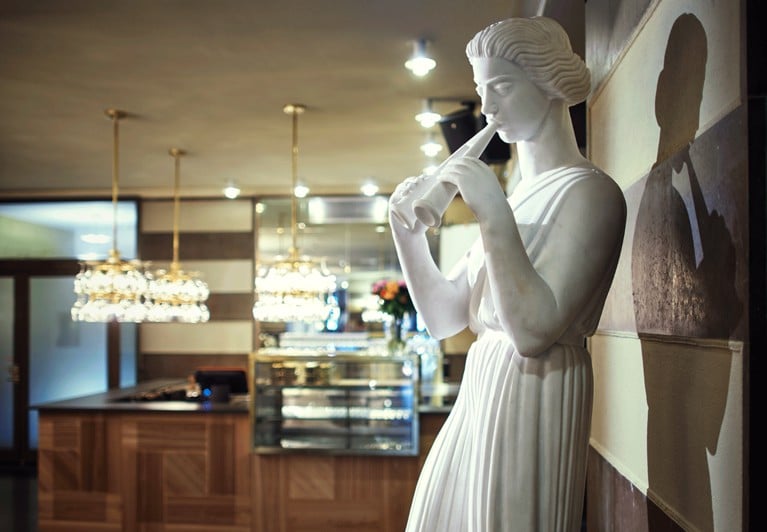
Join us for a tour of the art and decorative features of Konserthuset.
Ancient Greece
Visitors entering Konserthuset from Hötorget into the entrance hall – the so-called vestibule – immediately notice the thematic thread that runs through the building’s decoration: everything speaks of inspiration from Ancient Greece and of music, with instruments such as lyres and flutes recurring throughout.
The artist and designer Einar Forseth (1892–1988) created most of the decorative work in the vestibule and the Grand Foyer. The large floor mosaics in the vestibule are among his works, as are the plaster decorations.
Imaginative Creatures and Textiles
From the Grand Foyer, the main staircases to the left and right lead up to the stalls level of the Main Hall. The stair newels are the imaginative creations of Ansgar Almqvist – the small mounted figures at the lower ends of the banisters.
Textiles by Elsa Gullberg (1886–1984) adorn these staircases. Before the refurbishment in the 1970s, they hung in the Main Hall but were relocated for, among other reasons, acoustic considerations.
Nils Olsson (1892–1973) and Robert Nilsson (1894–1980) executed all the plaster reliefs in the ceilings and on the columns, as well as the composer portraits in plaster above the doors leading into the stalls level of the Main Hall. On the left-hand side of the stalls are Palestrina, Bach, Handel, Haydn, Mozart and Beethoven; on the right-hand side, Schubert, Schumann, Wagner, Bruckner, Brahms and Franck. Each portrait is accompanied by a musical quotation.
Narrative Intarsia
From the stalls level, staircases lead up to the more elegant surroundings of the First Balcony. Here one finds Ewald Dahlskog’s exquisite intarsia work on the nine pairs of doors to the Main Hall. Each door depicts the history of musical instruments from around the world, with playful and imaginative details. Dahlskog also painted the supraportes along the First Balcony promenade – the corridor linking the foyer spaces with the refreshment areas on either side.
The collaboration between Einar Forseth and Elsa Gullberg’s weaving studio resulted in textiles that once featured throughout Konserthuset. In the Main Hall, woven hangings were suspended from the balconies, and the foyers were furnished with draperies and carpets. Most have succumbed to the wear of time, and in some cases only fragments remain.
Dancing Stools
With support from foundations including the Jacob Wallenberg Foundation and the Prince Carl Gustaf Foundation, and at the initiative of Åke Livstedt, new textiles have been commissioned for other parts of the building. Inspired by the pattern of the earlier carpets, the textile artist Kajsa Melanton (1920–2012) designed new runners for the foyers around the First Balcony.
The carpet in the Erling Persson Room (formerly King Gustav V’s Salon), a separate foyer, is also by Kajsa Melanton, as are the draperies in the stalls promenade one level below, entitled Dancing Stools.
Glass light fittings and mirrors were designed by Simon Gate (1883–1945) and Edward Hald (1883–1980) at the Orrefors glassworks. Some of the fittings are subtly tinted blue to create a daylight-like glow.
Carl Malmsten – Please, Take a Seat
When Ivar Tengbom created Konserthuset in the mid-1920s, he engaged many of the leading artists and designers of the time. The furniture for the public foyers was designed by the furniture designer Carl Malmsten (1888–1972), and these original pieces – chairs, tables and benches – are still in use by visitors today.
The Grand Foyer at the lower level now features more contemporary furnishings, but in most of the other foyers Carl Malmsten’s furniture remains. In 2018, an extensive restoration was undertaken to return the Malmsten furniture as closely as possible to its original appearance. Furniture conservators, decorative painters, cabinet-makers, upholsterers, saddlers and glaziers carried out meticulous work: earlier “corrections” that had accumulated over the years – repairs, renovations using synthetic materials and the like – were addressed, and the furniture has now been restored to its original condition.
Visitors to Konserthuset enjoy and make use of a cultural heritage preserved in situ, at the heart of a living public environment.