Genre: Royal Stockholm Philharmonic Orchestra

Dmitrij Sjostakovitj Symphony No. 9

A long-awaited victory symphony turned out to be something quite different.

When the Second World War ended in 1945, expectations surrounding Dmitri Shostakovich’s Ninth Symphony were high. He himself had spoken of a grand work for soloists, chorus and orchestra, celebrating the victory. But by the time the symphony was completed in August that year, his plans had changed radically.

Instead of monumental pomp, Shostakovich wrote a compact five-movement symphony characterised by transparency, wit and Classical models such as Haydn. The cheerfully bustling first movement is full of sudden ideas and unexpected interruptions, while the second begins with a quiet clarinet melody that gradually takes on the character of a dark and melancholy waltz.

The final three movements follow without a break. A swift and incisive Presto gives way to a stern Largo, in which powerful brass chords are set against a solitary, expressive bassoon solo. The bassoon then leads directly into the finale, which builds towards an increasingly exuberant, almost circus-like conclusion.

Shostakovich himself emphasised the symphony’s “transparent, clear and bright mood”. Yet it was precisely this lightness that proved provocative in the Soviet Union, where a heroic celebration of victory had been expected. The symphony was first performed in Leningrad in November 1945 and was officially banned in 1948.

  • The music

  • Dmitrij Sjostakovitj Symphony No. 9
  • Participants

  • Royal Stockholm Philharmonic Orchestra
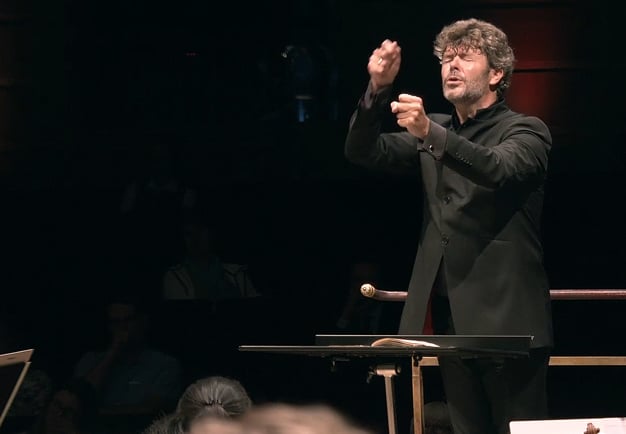
  • Pablo Heras-Casado conductor

About the video

  • Filmed 26 August 2020.
  • The video is approximately 28 minutes.

Watch in our app

The Konserthuset Play app makes it easier to experience music on your phone or tablet – or on a big screen! Read more

FAQ about Konserthuset Play

Our tips for how to best take advantage of our selection and how you watch our livestreams. To FAQ

Genre: Royal Stockholm Philharmonic Orchestra

Dmitrij Sjostakovitj Symphony No. 9

A long-awaited victory symphony turned out to be something quite different.

About the video

  • Filmed 26 August 2020.
  • The video is approximately 28 minutes.

When the Second World War ended in 1945, expectations surrounding Dmitri Shostakovich’s Ninth Symphony were high. He himself had spoken of a grand work for soloists, chorus and orchestra, celebrating the victory. But by the time the symphony was completed in August that year, his plans had changed radically.

Instead of monumental pomp, Shostakovich wrote a compact five-movement symphony characterised by transparency, wit and Classical models such as Haydn. The cheerfully bustling first movement is full of sudden ideas and unexpected interruptions, while the second begins with a quiet clarinet melody that gradually takes on the character of a dark and melancholy waltz.

The final three movements follow without a break. A swift and incisive Presto gives way to a stern Largo, in which powerful brass chords are set against a solitary, expressive bassoon solo. The bassoon then leads directly into the finale, which builds towards an increasingly exuberant, almost circus-like conclusion.

Shostakovich himself emphasised the symphony’s “transparent, clear and bright mood”. Yet it was precisely this lightness that proved provocative in the Soviet Union, where a heroic celebration of victory had been expected. The symphony was first performed in Leningrad in November 1945 and was officially banned in 1948.

  • The music

  • Dmitrij Sjostakovitj Symphony No. 9
  • Participants

  • Royal Stockholm Philharmonic Orchestra
  • Pablo Heras-Casado conductor

Watch in our app

The Konserthuset Play app makes it easier to experience music on your phone or tablet – or on a big screen! Read more

FAQ about Konserthuset Play

Our tips for how to best take advantage of our selection and how you watch our livestreams. To FAQ